




Levels of Care
PHP vs. IOP vs. OP: Levels of Care Explained
Published Apr 21, 2026 · Updated Jul 8, 2026
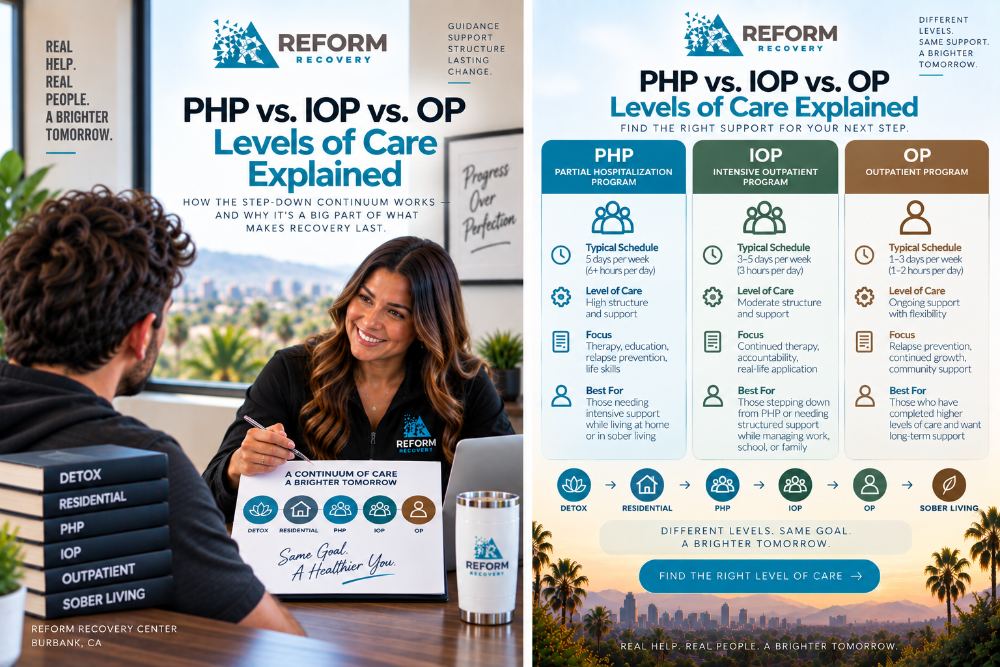
PHP, IOP, and OP are three outpatient levels of care that decrease in intensity as you build stability. Together they form a "step-down" continuum that keeps support in place while you return to daily life.
PHP — Partial Hospitalization Program
The most structured outpatient level: full-day treatment about five days a week. PHP combines individual therapy, group therapy, life skills, and recovery education, while you return home or to sober living each evening. Most people spend 4–12 weeks here.
IOP — Intensive Outpatient Program
As you stabilize, IOP offers continued clinical support with more flexibility — typically 3–5 days a week — so you can begin returning to work, school, and family. It emphasizes relapse prevention and practicing new skills in real life.
OP — Outpatient Program
The lightest level: usually 1–2 days a week. OP keeps you connected to therapy and accountability as you build a healthy, independent, sustainable life in recovery, often for several months.
Why the step-down matters
Recovery isn't a single event — it's a series of steps. Moving gradually from higher to lower intensity keeps a safety net in place while you rebuild your life, which is a big part of why it works.
Ready to take the first step?
One confidential call is all it takes. We'll verify your insurance and handle the details.
Call 844-R-REFORMSources
- NIDA — Treatment
- SAMHSA — FindTreatment.gov
- National Institute on Drug Abuse (NIDA) — Treatment and Recovery
These trusted, publicly available sources informed this article. Reform Recovery Center is not affiliated with and does not endorse these organizations; links are provided for educational reference.
This article is educational and is not medical advice or a substitute for professional care. If you or someone you love is in immediate danger, call 911. For emotional crisis or suicide support, call or text 988, 24/7.